


7 Essential Stages to Becoming a Software Architect
7 Essential Stages to Becoming a Software Architect
Whether you are upgrading existing systems or investing in new Bespoke software for your business, the involvement of a Software Architect is a critical factor for success. Their role extends far beyond technical coding; they provide the strategic foundation and high-level design necessary for a robust digital product.
1. Strategic Business Alignment
A Software Architect possesses the strategic vision required to align software development with your specific commercial goals. By planning a comprehensive project roadmap, they ensure the final product directly supports your long-term business objectives rather than just meeting immediate technical requirements.
2. Innovation and Competitive Advantage
Leveraging extensive industry knowledge, architects introduce innovative solutions and cutting-edge technologies. This forward-thinking approach ensures your Bespoke software provides a distinct competitive edge within your market.
3. Quality Assurance and Risk Mitigation
Architects maintain rigorous quality standards throughout the development lifecycle. They ensure the software is functional, secure and compliant with relevant industry regulations. By identifying potential risks early, they implement mitigation strategies that prevent expensive or time-consuming issues in the future.
4. Scalability and Future Proofing
Bespoke software is designed with future expansion in mind. An architect ensures the system architecture is scalable, allowing it to remain relevant and adaptable as your business grows or as new technological advancements emerge.
5. Maximising Return on Investment
While engaging a Software Architect represents an initial investment, the long-term value of an efficient and well-designed system is significant. A professionally architected solution reduces technical debt and maintenance costs, leading to a much higher return on investment over the software's lifespan.
6. Holistic System Integration
Beyond the core code, architects consider the broader ecosystem. This includes seamless integration with existing systems, robust data security protocols and an optimised user experience.
In summary, a Software Architect brings a vital blend of technical expertise and leadership to complex projects. Their involvement is an invaluable asset for any Bespoke software endeavour, ensuring a high-quality result that delivers lasting business value.
technical requirements to Become a Software Architect
Training to become a Software Architect represents a significant milestone in a technical career. It marks the transition from executing code to designing the high-level solutions that define a system’s success.
This journey requires a deliberate blend of academic grounding, hands-on engineering and commercial acumen.
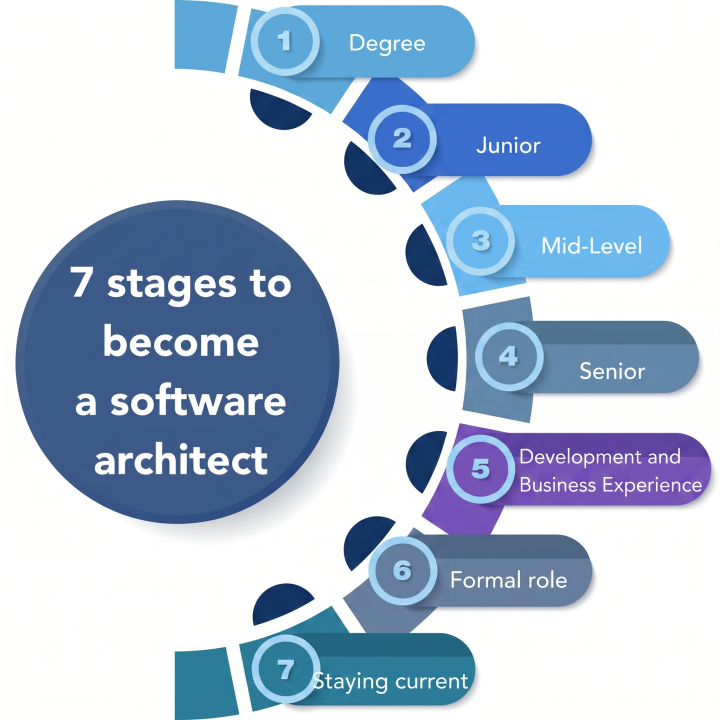
Education and career
1. Degree in Computer Science or Related Field
The foundation of any architectural career typically begins with a formal education. A Bachelor’s degree in Computer Science, Software Engineering, or Information Technology provides the essential theoretical framework. This stage is critical for understanding fundamental principles such as data structures, algorithms and computer architecture. These core concepts remain the building blocks for even the most complex global systems.
2. Junior Developer Role
Entering the industry as a Junior Developer is where theory meets practice. In this stage, the focus is on mastering the basics of professional software development. Junior roles provide invaluable experience in writing clean code, understanding version control and navigating the software development lifecycle (SDLC). It is a time for active learning, debugging and contributing to small-scale project tasks under mentorship.
3. Mid-Level Developer Experience
As you transition into a mid-level role, the scope of your responsibility broadens. At this stage, you begin to take ownership of larger features and more complex components. Mid-level developers focus on mastering specific tech stacks and frameworks while refining their problem-solving abilities. This is also the ideal period to start specialising in niche areas such as cloud infrastructure, database management, or specific programming paradigms.
4. Senior Developer or Lead Position
Seniority is characterised by a shift from following instructions to guiding technical direction. Senior Developers are expected to mentor junior staff, conduct rigorous code reviews and take responsibility for the stability of significant system segments. At this stage, you begin making local architectural decisions, such as choosing libraries or defining internal service interfaces, which serves as a testing ground for high-level design.
5. Development and Business Experience
A Software Architect does not work in a technical vacuum. This critical stage involves gaining a deep understanding of the relationship between code and commercial value. You must learn to bridge the gap between technical requirements and business objectives. This involves understanding stakeholder needs, budgeting constraints and market demands. An architect’s value lies in their ability to design systems that are not just technically sound, but commercially viable.
6. Transitioning into the Formal Role
Reaching the formal role of Software Architect means stepping back from day-to-day coding to focus on system-wide design. Your primary responsibility becomes defining the overarching architecture, making high-level design choices and establishing the technical standards that all teams must follow. You are now the technical authority responsible for system scalability, security and long-term maintainability.
7. Staying Current and Continuous Learning
The final stage is an ongoing commitment. The technology landscape is in a constant state of flux, with new methodologies and tools emerging annually. To remain effective, a Software Architect must engage in continuous professional development. This includes attending industry conferences, pursuing advanced certifications and staying active within the tech community. Staying current ensures your architectural designs remain modern, resilient and competitive.
non-technical requirements to Become a Software Architect
While technical mastery is the foundation of any Software Architect’s career, the ability to successfully lead complex projects rests heavily on interpersonal excellence.
In the modern engineering landscape, an architect acts as the vital bridge between high-level business strategy and technical execution, a role that demands much more than just coding proficiency.
Mastering these seven essential non-technical requirements ensures that you can effectively manage stakeholders, mentor development teams and align technical decisions with commercial goals.
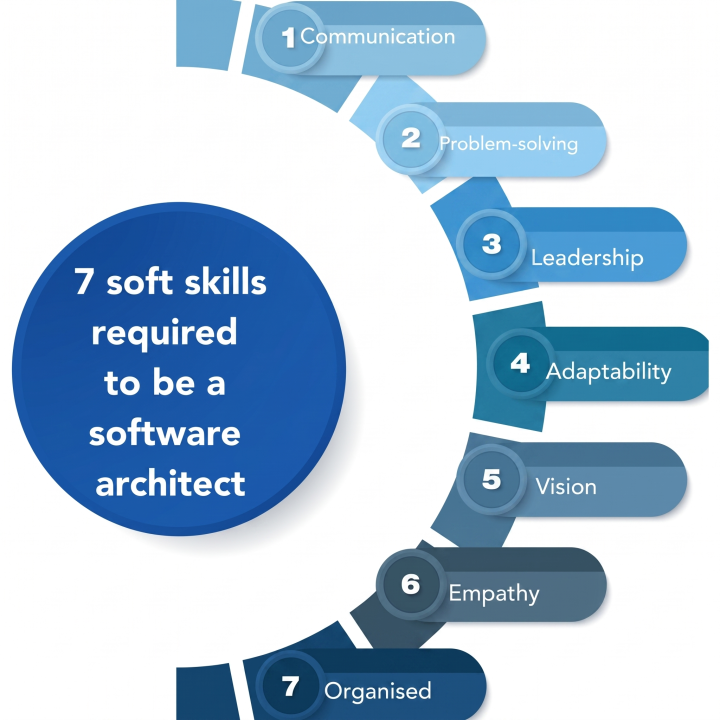
1. Communication Skills
Effective communication is vital. You act as a strategic translator, bridging the gap between non-technical business goals and precise technical implementation. You must convey complex ideas, constraints and risks clearly to diverse stakeholders, focusing on commercial impact rather than just technical detail.
2. Problem-Solving Abilities
System design is fundamentally about practical problem-solving. Architects must look beyond single features to design holistic solutions that integrate services, manage complex data and meet rigorous performance demands. This requires foresight to identify potential failures and pragmatism to balance ideal technical solutions with real-world constraints.
3. Leadership and Team Management
Architects are essential technical leaders. While often without direct authority, you set the standards, best practices and engineering culture. You guide teams through complex decisions, ensure alignment with long-term strategy and provide crucial mentorship to elevate the overall engineering skillset.
4. Adaptability and Flexibility
The technological landscape changes constantly. An effective architect must be inherently adaptable, staying current with new methodologies and cloud services. You must impartially evaluate new solutions and be willing to pivot designs as business needs and technology shift.
5. Vision and Strategic Thinking
A strategic, long-term vision is critical. While teams focus on immediate features, the architect must visualise the entire system’s evolution over the next six months to two years. This foresight ensures that foundational technical choices enable long-term business success.
6. Empathy and Interpersonal Skills
User-centric design requires genuine empathy. You must understand the developer's journey, designing systems that are maintainable and loosely coupled. Simultaneously, you must appreciate stakeholder concerns regarding budget and deadlines, reducing friction and building necessary trust.
7. Time Management and Organisation
Architects must bring order to complexity. Juggling multiple system components and competing priorities demands exceptional organisational skills. You must proactively prioritise high-impact decisions and allocate time effectively for research and prototyping.
Software architects are pivotal in transforming visionary ideas into remarkable and efficient software solutions, orchestrating the technical and strategic elements of development to create systems that are not only innovative but also scalable, robust and perfectly tailored to meet the dynamic needs of businesses.
Contact us now to have a chat with our Software Architect, Stuart Elliott. He has 2 decades of business and software development experience, he knows what he's talking about! bespokeuk.com/contact

2026 Colours trends for website design
2026 Colour Trends for Website Design Digital spaces are undergoing a prof...
8 min read

Google analytics dropping?
1. Google Analytics The old version of Google Analytics (known as Universa...
5 min read

Stop business subscriptions with Bespoke software
Subscription Creep: hidden system costs Many business owners genuinely bel...
7 min read

cyber attacks and data breaches security guide
cyber attacks and data breaches security guide The Cyber Attack (The Actio...
5 min read
Is integrating systems into Bespoke software scaring you?
Navigating the Integration Journey: A Strategic Evolution As businesses em...
3 min read

AI - Game Changer for Data Management
Data classification can feel like trying to sort through a mountain of pape...
6 min read