


cyber attacks and data breaches security guide
cyber attacks and data breaches security guide
The Cyber Attack (The Action)
A cyber attack is an intentional attempt by an external or internal threat to bypass security, disable computers or steal data. It is the "breaking and entering" part of the crime.
- Examples: Phishing emails, malware, ransomware, or "denial of service" (DDoS) attacks that crash your website.
- Goal: The goal might be to steal money, shut down your business operations, or simply cause chaos.
The Data Breach (The Result)
A data breach is a security incident where sensitive, protected, or confidential data is copied, transmitted, viewed or stolen by an unauthorised person. It is the "stolen goods" part of the crime.
- Examples: A hacker successfully downloading your customer list, an employee accidentally emailing a spreadsheet to the wrong person or a lost laptop containing unencrypted files.
- Goal: The focus is specifically on the compromise of information.
Key Differences at a Glance
| Feature | Cyber Attack | Data Breach |
| Definition | The offensive strike or method used. | The actual loss or exposure of data. |
| Intent | Always malicious and intentional. | Can be malicious or accidental. |
| Outcome | Could result in a breach, or just downtime. | Results in a violation of privacy/security. |
| UK Law | Covered by Computer Misuse Act. | Covered by UK GDPR and Data Protection Act. |
Why the distinction matters for Bespoke Software solutions
You can suffer a cyber attack (like a virus that slows down your servers) without having a data breach. Conversely, you can have a data breach (like a staff member leaving a file on a train) without a cyber attack.
Bespoke software helps defend against both. It prevents attacks by using custom code that hackers aren't familiar with and it prevents breaches by using automated workflows that remove the "human error" of handling sensitive files manually.
The financial and operational reality of cyber security has shifted from a technical concern to a fundamental business risk. For UK organisations, the question is no longer if a data breach will occur, but whether the business is resilient enough to survive the aftermath. According to the April 2026 Cyber Security Breaches Survey, approximately 612,000 UK businesses (43%) reported experiencing a data breach or cyber attack in the preceding 12 months.
1. The escalating financial burden of a cyber attack
Government data from the 2025/2026 report reveals that the financial impact of cyber attacks are growing. While the average cost of the most disruptive breach was estimated at £1,600 for businesses in 2025, that figure rises to £3,550 when looking only at breaches that resulted in a direct financial cost. Larger organisations frequently face losses in the hundreds of thousands. These costs are not just direct financial thefts; they include hiring forensic experts to investigate the compromise, legal fees for regulatory compliance and the urgent implementation of security measures that were previously overlooked.
2. Operational paralysis and productivity loss
One of the most immediate impacts of a data breach is the total cessation of business operations. In the 2025/2026 survey period, an increasing number of businesses reported that cyber attacks led to a loss of revenue or share value (up to 5% from 2% the previous year). When Legacy systems fail under the weight of an attack, employees are left unable to access critical files or networks. This period of forced downtime results in a massive loss of billable hours and internal productivity. For a business operating on thin margins, even forty eight hours of operational standstill can create a deficit that takes months to recover.
3. Long term reputational damage and client trust
Digital trust is difficult to build and remarkably easy to destroy. Under UK GDPR, businesses are legally required to report significant data breaches to the Information Commissioner’s Office and affected individuals. The 2025/2026 findings showed a significant rise in businesses reporting reputational damage following a cyber attack (increasing to 3% from 1% in the 2024/2025 period). The fallout from informing your client base that their sensitive data has been compromised often leads to immediate contract cancellations and a long term decline in new business acquisition.
4. The strategic advantage of bespoke software over legacy systems
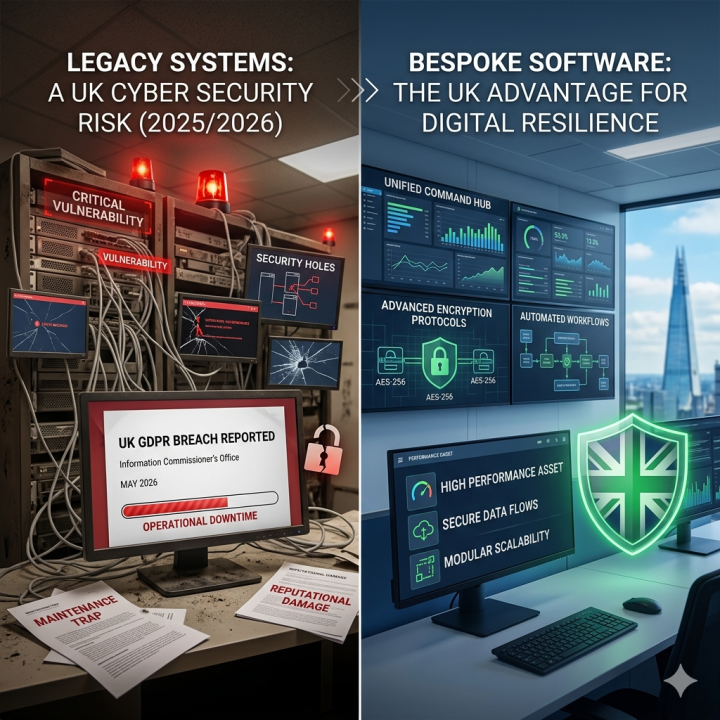
Legacy systems are frequently the weakest link in a company’s security posture. These ageing infrastructures often rely on obsolete programming languages that no longer receive security patches, creating a maintenance trap where costs spiral while protection diminishes. In contrast, Bespoke software solutions are designed with security at its core. By building a custom software solution, an business can implement modular scalability and advanced encryption protocols tailored specifically to its unique requirements. This proactive approach eliminates the unpatched risks inherent in outdated, off-the shelf-systems.
5. Integration and automation for enhanced security
Beyond protection, Bespoke solutions offer integration capabilities that Legacy systems cannot match. While older software often operates in silos, modern custom applications act as a unified command hub, this allows for the seamless automation of complex processes, significantly reducing the likelihood of human error, which remained a leading cause of data breaches in the UK throughout 2025. Investing in Bespoke software is not merely a technical upgrade; it is a strategic decision to replace technical debt with a high performance asset that supports sustainable business growth.
6. Impartial advice for your digital resilience
Balancing the risk of Legacy system failure against the investment required for Bespoke software is a complex challenge. Whether you are currently navigating a security crisis or looking to audit your existing infrastructure, expert guidance is essential. Our Bespoke software development experts provide impartial technology reviews to help you understand your vulnerabilities and find the right path forward, even if our Bespoke solutions are not the immediate answer for your business.
Contact us today to ensure your organisation is not just another statistic in the next cyber security report. bespokeuk.com/contact
2026 Colours trends for website design
2026 Colour Trends for Website Design Digital spaces are undergoing a prof...
8 min read

Google analytics dropping?
1. Google Analytics The old version of Google Analytics (known as Universa...
5 min read

Stop business subscriptions with Bespoke software
Subscription Creep: hidden system costs Many business owners genuinely bel...
7 min read

10 tips in finding your ideal E-commerce partner
Creating a thriving e-commerce platform with a seamless and efficient shopp...
6 min read

Business Plans - Comprehensive Guide Part 2
What are the different types of Business Plans and how to carry out a SWOT...
9 min read

Shopify alternatives A comprehensive guide 2025
In the realm of e-commerce, Shopify has been a dominant player for years, r...
6 min read