


The real cost of disconnected business systems
the hidden costs of fragmented business tools
Many small and medium businesses across the UK reach a point where operations begin to feel heavy. You add an e-commerce platform to increase sales, a standalone CRM to track leads and an accounting tool to manage invoices, on their own, each of these applications works perfectly well, the trouble starts when these disconnected business systems cannot talk to one another. They become isolated information silos, instead of a smooth digital workflow, you end up with a tangled tech stack that actively drains your time, energy and profits behind the scenes. This friction is the real, hidden costs of fragmented business tools.
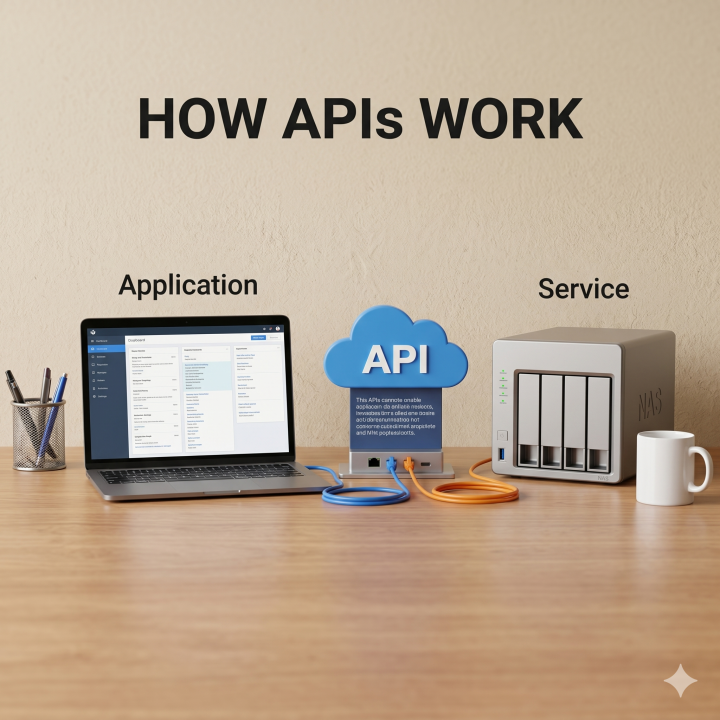
Application Programming Interfaces (APIs) are the unsung heroes of modern digital infrastructure. They are not apps or systems themselves, but rather rules and protocols that allow software applications to “talk” to each other.
Think of APIs as translators or messengers. They enable two applications to share data, perform tasks or trigger actions, often in real time and with minimal manual intervention.
Common reasons API's are needed:
- Your industry has regulatory or operational requirements not addressed by off-the-shelf tools
- Existing systems have no native integration or limited API capabilities
- You want a central “command centre” tailored precisely to your business model
- Off the shelf connectors don’t handle your complexity or scale
- You're managing legacy infrastructure alongside modern platforms
Let’s explore this issue in depth, including:
- What does 'fragmented business tools' actually means
- Why it's so common across industries?
- The consequences for your business
- How APIs (Application Programming Interfaces) offer a practical, scalable solution
- Best practices for implementing API led integration
- Benefits of API driven integration
- Real world use cases from various sectors
- Common mistakes to avoid
- Integration is no longer optional
DID YOU KNOW
Every time you check the weather, log in with Google/Facebook, or use GPS, you're making API calls. Most apps use 50–100 different APIs behind the scenes.
1. What Does “fragmented business tools” Really Mean?
Fragmented business tools refers to the failure of IT systems, platforms or applications to communicate effectively, either due to technical limitations, outdated architecture or a lack of interoperability planning.
Examples include:
- A CRM that doesn’t sync with your marketing platform
- A finance tool that doesn’t pull data from your sales platform
- An HR system that doesn’t connect with payroll or benefits management
- Customer data stored in multiple places, with different formats
- Repetitive tasks being performed manually due to lack of system connectivity
While the business world often champions digital transformation, it’s frequently done fragmentally, a tool here, a platform there, with little thought given to how these systems will interoperate.
2. why it's so common across industries?
There are several reasons why system integration is often neglected or improperly executed:
a. Legacy Systems
Many organisations, particularly in industries like healthcare, banking and manufacturing, still rely on legacy systems built decades ago. These were never designed to interface with cloud based or modern applications, making integration incredibly challenging.
b. Departmental Procurement
Different departments often choose business tools independently, without IT oversight or strategic alignment, this leads to a fragmented tech stack and minimal cross compatibility.
c. Growth Without Planning
Fast growing companies often implement new systems rapidly to meet immediate needs, without a long term integration roadmap, over time, this results in a tangled web of disconnected business tools.
d. Lack of Technical Resources
Many small and medium sized enterprises (SMEs) lack the in house expertise to properly connect systems or build custom integrations.
3. The consequences for your business
The real cost of fragmented business software extends far beyond IT frustrations, it can severely impact performance, compliance, customer satisfaction and profitability.
a. Inefficient Operations
Staff waste countless hours on repetitive tasks, such as exporting/importing spreadsheets, manually updating records or verifying data accuracy across platforms, this slows down workflows, increases human error and limits overall productivity.
b. Data Inaccuracy and Duplication
When systems don’t synchronise, data becomes fragmented. Different departments may work with conflicting versions of the same information, undermining reporting, forecasting and decision making.
c. Security and Compliance Risks
Siloed data can lead to gaps in visibility, weak access controls and audit challenges. For industries subject to strict regulations (like GDPR), disconnected business software increases legal and financial risks.
d. Customer Experience Breakdown
Customers expect seamless, responsive service. If your support team lacks access to order history or communication records or your marketing team sends irrelevant messages due to outdated data, customer trust can quickly erode.
e. Limited Scalability
When systems don’t integrate, adding new functionality or scaling up processes becomes more expensive and complex. Businesses end up hitting a “growth ceiling” much sooner than necessary.
4. How bespoke APIs offer a practical, scalable solution
While off the shelf tools and public APIs offer a solid foundation for integration, they’re not always a perfect fit, especially for organisations with unique workflows, niche industry requirements or complex legacy systems.
This is where Bespoke software developed API's comes into its own.
Custom built applications can be designed to either:
APIs Can Be Used To:
- Sync customer data between a CRM and a marketing automation platform
- Automatically generate invoices in an accounting system after a sale is completed
- Update inventory levels across multiple sales channels
- Integrate a website’s contact form with a helpdesk ticketing system
- Send real time alerts when specific business thresholds are crossed (e.g. low stock, failed payments)
a. Unify Multiple Systems into a Single Platform
Bespoke software can consolidate core business functions, such as CRM, finance, HR, inventory, customer service and project management, into one cohesive interface. This eliminates the need to manage dozens of fragmented business tools and creates a streamlined user experience.
Instead of staff jumping between six platforms and spreadsheets, everything lives in a centralised environment tailored to how your business operates.
b. Act as a Smart Connector Between Existing Tools
In some cases, it’s neither practical nor cost effective to replace existing systems. Bespoke integration software solutions can serve as an intelligent middleware layer, bridging gaps between platforms that otherwise don’t natively integrate.
These custom connectors can:
- Pull and push data between APIs in a specific sequence
- Transform and clean data during transmission
- Trigger workflows based on custom business logic
- Provide dashboards for monitoring and reporting across systems
The flexibility of Bespoke software means it can work around the limitations of third party APIs, adapt to changing requirements and ensure complete control over how data flows across your business.
5. Best practices for implementing API led integration
a. Adopt an API First Mindset
When evaluating new business system always ask: Does it offer robust API support?
b. Use a Central Integration Platform (iPaaS)
Business software like MuleSoft, Zapier, Boomi, or Make can simplify complex integrations without heavy coding.
c. Establish Data Standards
Ensure consistency in how data is formatted and labelled across systems. APIs work best when the data they handle is clean and structured.
d. Prioritise Security
Use authentication protocols like OAuth and always encrypt sensitive data during transit.
e. Monitor and Document
Maintain clear documentation for your APIs and monitor usage to detect performance or security issues early.
DID YOU KNOW
Over 90% of Developers Use API's Daily
Every time you check the weather, log in with Google/Facebook or use GPS, you're making API calls. Most apps use 50–100 different APIs behind the scenes.
6. Benefits of API Driven Integration
a. Real Time Data Synchronisation
APIs ensure that changes made in one system are reflected immediately in others, ensuring a consistent and up to date single source of truth.
b. Process Automation
Tasks that once required human input can be fully automated, improving speed, accuracy and operational efficiency.
c. Improved User Experience
Staff no longer need to toggle between systems or duplicate efforts. Customers benefit from faster, more personalised service.
d. Scalability and Flexibility
Need to add a new analytics platform or switch CRMs? With APIs in place, changes can be made quickly without having to rebuild entire workflows.
e. Reduced IT Burden
Modern APIs are designed to be modular and reusable, which means IT teams spend less time maintaining custom integrations and more time on innovation.
7. Real world use cases from various sectors
Retail & Ecommerce
Integration between POS systems, inventory management, customer loyalty platforms and marketing software ensures stock accuracy, smooth checkout and personalised offers.
Financial Services
APIs help connect frontend applications with secure backend databases, fraud detection systems and compliance tools to streamline onboarding and improve transaction transparency.
Healthcare
Secure API connections between EHRs (Electronic Health Records), appointment systems, billing software and diagnostic tools ensure timely care and accurate record keeping.
Manufacturing
APIs can connect ERP systems, supply chain platforms, production management tools and warehouse software to create a single, responsive operations dashboard.
Education
Student information systems, virtual learning platforms, attendance tracking and parent communication tools can be integrated to deliver a consistent, personalised learning experience.
8. Common mistakes to Avoid
- Building one off, hardcoded integrations that are difficult to maintain
- Choosing systems with limited or proprietary API support
- Failing to plan for version updates or changes to third party APIs
- Ignoring the need for internal API governance or lifecycle management
- Overlooking the training needed for teams to leverage integrated systems properly
9. Integration Is No Longer Optional
Disconnected business software isn’t just a minor IT inconvenience, it’s a business risk. It affects productivity, customer loyalty, employee satisfaction and your ability to compete in an increasingly digital world.
APIs provide the key to unlocking a truly connected enterprise. Whether you’re a start-up scaling operations or an established company undergoing digital transformation, investing in proper integration is one of the smartest, most future proof decisions you can make.
Bespoke + APIs = Total Control
While APIs form the backbone of integration, Bespoke software gives you the flexibility, customisation and precision to make those APIs work exactly the way your organisation needs.
This hybrid approach, using APIs to connect systems and Bespoke software solutions and architecture to orchestrate them, results in a unified, intelligent and scalable digital ecosystem.
Contact us now and discuss how our Bespoke API's can get all your systems talking

2026 Colours trends for website design
2026 Colour Trends for Website Design Digital spaces are undergoing a prof...
8 min read

Google analytics dropping?
1. Google Analytics The old version of Google Analytics (known as Universa...
5 min read

Stop business subscriptions with Bespoke software
Subscription Creep: hidden system costs Many business owners genuinely bel...
7 min read

What is the Agile Development Model?
HOW AGILE ARE YOU AND YOUR BUSINESS? What is the Agile methodology? The...
7 min read

Business Sustainability audit – using the findings
Many businesses recognise the advantages of becoming more sustainable. Howe...
11 min read

Skills shortages, recruitment costs & the Bespoke Software Solution
In recent years, the UK has faced a myriad of workforce challenges that hav...
8 min read