


APIs Bespoke Software - A complete guide
The Ultimate Guide to APIs in Modern Business
In the digital economy, businesses no longer operate in isolation. Systems need to communicate with one another — seamlessly, securely, and in real time. This is where APIs (Application Programming Interfaces) come in. They act as the connectors, enabling different platforms, applications, and devices to share data and functionality.
Here’s a detailed guide to APIs, why they matter, the types available, and how to implement them effectively.
1. What is an API?
An API is a set of rules and tools that allows software applications to talk to each other. Think of it as a digital bridge: without APIs, E-commerce platforms couldn’t connect to payment providers, CRMs couldn’t sync with email tools, and mobile apps couldn’t access live data.
APIs are the hidden infrastructure behind everything from online bookings to social media logins.
2. Why Use APIs?
APIs bring flexibility and efficiency by allowing systems to connect rather than operate in silos.
a. General Data Management
- Streamline data flow across different systems.
- Reduce duplication and errors in record-keeping.
b. Sales & E-commerce
- Connect websites with payment gateways and logistics.
- Enable stock synchronisation across online and physical shops.
c. Marketing
- Link CRM and email platforms for personalised campaigns.
- Track user behaviour and run automated marketing sequences.
d. Customer Service
- Enable chatbots to access customer records in real time.
- Provide self-service portals powered by integrated data.
e. Analytics and Reporting
- Pull data from multiple sources into unified dashboards.
- Support better decision-making with richer insights.
Did you know
Over 80% of web traffic now flows through APis, highlighting their role as the backbone of digital business.
3. Types of APIs
APIs come in various forms depending on their purpose and visibility:
- Open APIs (Public APIs): Available for external developers (e.g., Google Maps API).
- Internal APIs: Used within an organisation to connect internal systems.
- Partner APIs: Shared between businesses for joint ventures or collaborations.
- Composite APIs: Bundle multiple services into one call, reducing complexity.
4. How APIs Work
APIs act as messengers between applications:
- E-commerce Systems: Request order data and send it to logistics providers.
- Finance Teams: Use APIs to link banking data directly into accounting software.
- Developers: Build integrations faster using standard API endpoints.
5. Business Need for Bespoke APIs
While off-the-shelf APIs exist, custom software development provides unique advantages:
- Tailored Integrations: Built specifically for your workflows.
- Security: Designed to meet your compliance requirements (GDPR, PCI DSS, etc.).
- Efficiency: Removes reliance on third-party connectors that may not fit perfectly.
- Scalability: Grows as your systems expand.
- Competitive Edge: Enables unique digital experiences.
6. Choosing the Right API Strategy
When planning your API approach:
- Map existing systems and integration points.
- Define what data must flow between applications.
- Choose whether to use open-source APIs, third-party connectors, or Bespoke builds.
- Factor in security, uptime, and scalability.
Did you know
Businesses that invest in API-led strategies grow 20% faster than competitors who don’t
.
7. Benefits of tailor made APIs
Creating APIs tailored to your business delivers:
- Customisation: Fits your workflows exactly.
- Integration: Links legacy and modern systems seamlessly.
- Efficiency: Reduces manual data entry and errors.
- Scalability: Handles increasing data volumes as you grow.
- Enhanced Security: Built to your compliance requirements.
- Unique Functionality: Gives you an edge in delivering services.
- Improved Reporting: Consolidates data from diverse sources.
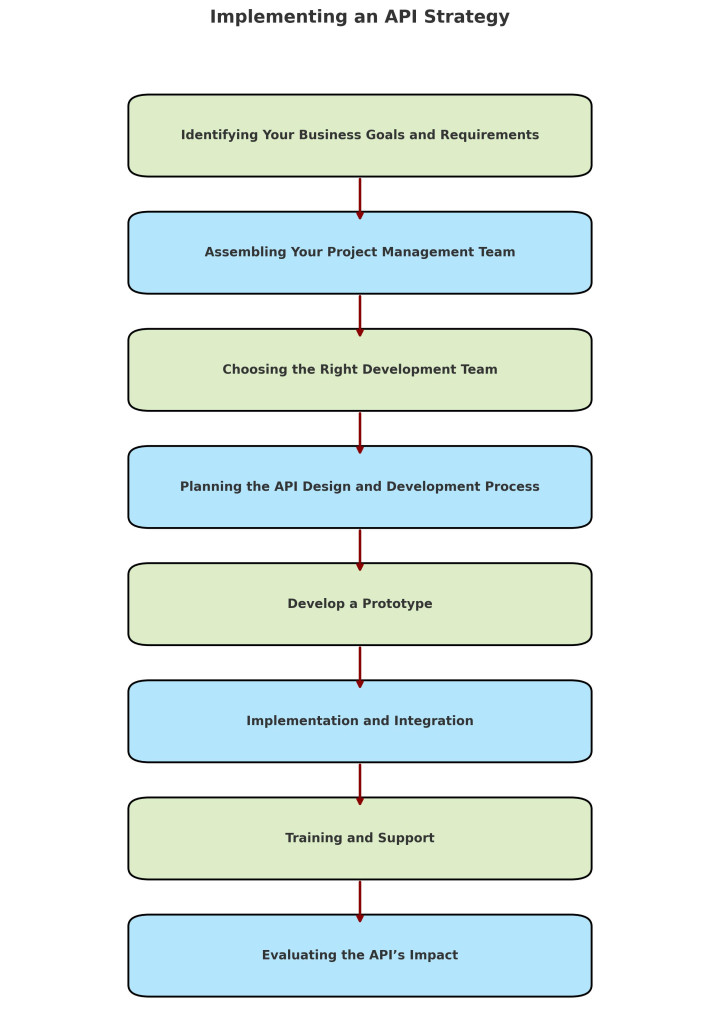
8. Implementing an API Strategy
a. Identifying Your Business Goals and Requirements
Determine which systems need to communicate and why.
b. Assembling Your Project Management Team
Involve IT leaders, developers, and department heads.
c. Choosing the Right Development Team
Select a team with experience in integration and security.
d. Planning the API Design and Development Process
Set objectives, milestones, and security protocols.
f. Develop a Prototype
Test integrations with sandbox environments before live deployment.
g. Implementation and Integration
Deploy APIs in phases, monitoring for errors and ensuring seamless data flow.
h. Training and Support
Train staff on using API-enabled features and ensure ongoing technical support.
i. Evaluating the API’s Impact
Measure improvements in efficiency, error reduction, and customer satisfaction.
APIs are no longer optional — they are the connective tissue of the modern business world. A Bespoke API strategy ensures your systems talk to each other efficiently, securely, and intelligently, giving you a genuine competitive edge.
From E-commerce integrations to real-time reporting, APIs power the digital experiences customers now expect.
Bespoke Api'S - that is what we DO!
Contact us now and find out how our SEASONED team can solve your businesses WORRIES USING our EXPERT Bespoke Software, created by US, personalised to you, maintained by US.
bespokeuk.com/contact

2026 Colours trends for website design
2026 Colour Trends for Website Design Digital spaces are undergoing a prof...
8 min read

Google analytics dropping?
1. Google Analytics The old version of Google Analytics (known as Universa...
5 min read

Stop business subscriptions with Bespoke software
Subscription Creep: hidden system costs Many business owners genuinely bel...
7 min read

E-commerce Basket Abandonment: Causes, Effects, and Solutions
E-commerce has reshaped the retail landscape, providing consumers with unpa...
6 min read

CRM Bespoke Software - A complete guide
In today’s fast-paced digital marketplace, managing customer relationships...
8 min read

Workflow Optimisation - Emerging Trends 2026
Bespoke Software in Workflow Optimisation Bespoke software, specifically d...
7 min read