


CRM Bespoke Software - A complete guide
In today’s fast-paced digital marketplace, managing customer relationships has become more than a back-office function, it is the heartbeat of sustainable growth.
A Customer Relationship Management (CRM) system is no longer a luxury for large corporations alone; it has evolved into an essential tool for organisations of every size, enabling them to capture insights, streamline interactions, and deliver personalised experiences at scale.
This comprehensive guide explores the fundamentals of CRM, the benefits it brings to businesses, and how the right approach can transform customer engagement into a long-term competitive advantage.
1. What is a CRM System?
A Customer Relationship Management (CRM) system is a sophisticated tool designed to help businesses manage their interactions and tasks with prospects and clients more effectively. Unlike traditional methods such as spreadsheets, emails, and sticky notes, CRM systems consolidate all information—ranging from contact details and communication history to sales pipelines and task reminders—into a single platform. This enables employees to operate more efficiently and in a systematic manner, optimising customer relationship management.
2. Why Use a CRM System?
As businesses expand, optimising operations—including prospect and client interactions—is crucial. CRM systems streamline a variety of tasks, facilitating:
a. General Contact Management
- Organising and storing client/prospect contact data.
- Tracking interactions and associated tasks.
b. Sales Management
- Managing sales pipelines from enquiry to deal closure.
- Automating sales processes to minimise manual efforts.
c. Marketing
- Managing email, social media, and other digital marketing activities.
- Designing targeted campaigns for higher engagement.
d. Customer Service
- Managing support tickets and customer service requests.
- Enabling direct client requests through portals and offering AI-driven solutions.
e. Analytics and Reporting
- Analysing customer data to generate insights for better decision-making.
DID YOU KNOW
Studies show that companies using CRM platforms see an average 29% increase in sales, 34% better sales productivity, and 42% more accurate forecasts.
3. Types of Crm
CRM systems come in various forms, generally categorised into:
Operational CRM: Streamlines and automates business processes (e.g., sales, marketing, service automation).
Analytical CRM: Evaluates customer data to enhance decision-making (e.g., data mining, predictive analytics).
Collaborative CRM: Improves communication between departments and with customers (e.g., interaction management, communication tools).
4. How CRM Systems Work
CRM systems consolidate and organise customer data from various touchpoints—emails, phone calls, social media, website visits etc. into a centralised database accessible by specific user groups. This enables:
Sales Teams: To manage leads, track sales progress, and automate routine tasks.
Marketing Teams: To segment customers and craft personalised campaigns.
Customer Service Teams: To handle support tickets and monitor issue resolution.
5. Business Need for Bespoke CRM Systems
When considering a bespoke CRM system, assess your current workflows, challenges, and growth objectives.
- Unique Workflows: Tailored to fit specific business processes.
- Integration Needs: Ensures seamless integration with existing tools.
- Data Analytics: Provides customised reporting beyond standard options.
- Scalability: Easily adapts to business growth and changes.
- User Experience: Custom interfaces improve adoption and effectiveness.
- Cost Implications: Higher initial costs can result in better long-term value.
6. Choosing the Right CRM System
Identify business requirements, understand current processes, and involve end-users in the decision-making process. Evaluate integration capabilities with existing tools, research available options, and weigh budget against costs to make an informed choice.
DID YOU KNOW
CRMs can cut admin time by 20%+ Automating data entry, scheduling, and reporting frees sales and service teams to focus on customers instead of paperwork.
7. Benefits of a Bespoke CRM System
Bespoke CRM systems offer:
- Customisation: Tailored to fit business processes.
- Integration: Works seamlessly with existing systems.
- Long-term Cost Efficiency: Avoids unnecessary features and licences.
- Scalability: Adapts easily to business changes.
- Enhanced User Experience: Improves onboarding and productivity.
- Unique Features: Provides a competitive edge.
- Improved Reporting: Custom insights aid decision-making.
- Data Security: Meets specific security and compliance needs.
8. Implementing a CRM System
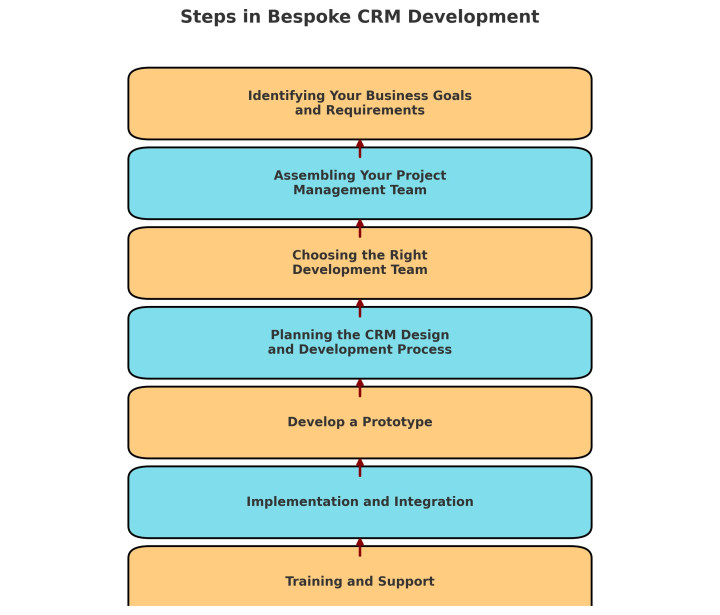
Partner with a reliable development company and follow these steps for CRM implementation:
- Plan Implementation: Assign roles, set timelines, and establish data migration plans.
- Customise/Implement: Configure settings and integrate necessary systems.
- Test System: Conduct rigorous testing and gather feedback.
- Train Users: Ensure comprehensive user training for effective use.
- Launch System: Roll it out strategically and monitor performance.
- Optimise Continuously: Continuously refine processes based on performance data.
a. Identifying Your Business Goals and Requirements
Successful bespoke CRM development begins with understanding your business goals and requirements.
Evaluate your business processes, identify areas for improvement, and determine how a custom CRM system can address these needs.
Consider the benefits of a bespoke CRM, such as enhanced customer service and greater efficiency in handling customer data.
Clearly defining your objectives early on will steer the development process, ensuring the final product aligns with your business's overarching goals.
b. Assembling Your Project Management Team
A bespoke CRM development project necessitates a skilled and dedicated project management team that offers a blend of experience and innovation.
This team should encompass professionals across various disciplines, including CRM design, UI/UX design, and advanced software development. Critical to success is the project manager, who manages communication and problem-solving, ensuring the project adheres to its defined path while maintaining high standards, laying the groundwork for bespoke CRM development success.
c. Choosing the Right Development Team
Selecting a development team with experience in creating bespoke CRM systems is crucial for the success of your project. It is important to seek out a team that possesses technical expertise as well as an understanding of your specific industry and its unique business processes. The right team will collaborate closely with you throughout the development journey, ensuring a final product that is functional, efficient, highly user-friendly, and intuitive.
Further details: bespokeuk.com/posts/why-is-it-so-beneficial-to-work-with-a-software-architect-for-your-bespoke
d. Planning the CRM Design and Development Process
Once your team is in place, the next step is to plan the CRM design and development process. This involves outlining the project scope, setting milestones, and establishing a timeline. Collaboration between the business analysts, UI/UX designers, and developers is vital during this phase to ensure the CRM solution is designed with the end user in mind and integrates seamlessly with existing systems and processes.
f. Develop a Prototype
Before full-scale development begins, it's advisable to create a prototype of your bespoke CRM. This allows you to visualise the CRM solution, test its functionality, and gather feedback from potential users. Prototyping is crucial for refining the CRM's design and usability, ensuring the final product is of high quality and meets your business needs.
g. Implementation and Integration
Following the successful development and testing of your bespoke CRM, the next phase is implementation and integration into your current systems.
This step requires careful handling to ensure a smooth transition and seamless integration, facilitating efficient management of customer data and optimisation of business processes.
Your development team should provide comprehensive support throughout this phase, addressing potential issues and ensuring the CRM system operates as intended. This will minimise disruptions and enhance user adoption by guaranteeing that all functionalities align with your business’s unique workflows and requirements.
h. Training and Support
To maximise the benefits of your bespoke CRM, comprehensive staff training is essential. This phase ensures each team member knows how to navigate the CRM system and provides them with the opportunity to learn how to utilise its diverse features to enhance customer service and optimise business operations.
The transition to a new CRM can often be complex, so tailored training sessions designed to meet the specific needs of different user groups within your organisation are essential.
Additionally, ongoing support from your development team is crucial for the CRM’s long-term success. This support should encompass everything from addressing immediate post-deployment challenges to assisting with future needs, including system updates, introducing new features, and troubleshooting unexpected issues.
A robust support framework is key to ensuring that the CRM system remains responsive to your business's evolving requirements.
i. Evaluating the CRM's Impact
The final step in bespoke CRM implementation involves evaluating its impact on your business.
Your business should conduct regular assessments to ascertain how the CRM has directly influenced customer satisfaction levels, streamlined existing business processes, and helped achieve strategic business goals. This evaluation should measure the benefits gained and highlight areas that might require further enhancement.
Continually measuring the CRM's effectiveness ensures that the system meets current business needs and is flexible enough to adapt to future challenges. This ongoing evaluation also supports continuous improvement, ensuring your bespoke CRM evolves alongside your business.
By following this step-by-step guide, you can be sure that your CRM solution is meticulously planned, expertly developed, and seamlessly integrated into your business operations.
Developing a bespoke CRM system is a considerable project, but it offers immense rewards.
By doing so, you can unlock the full potential of custom CRM software, improving customer satisfaction and achieving business excellence. Remember, a bespoke CRM is not just a tool but a strategic investment in your business's future, offering you the chance to gain an edge in competitive markets.
CRM systems, whether bespoke or off-the-shelf, are essential for enhancing customer relationships and streamlining operations. They improve sales, marketing, and customer service by centralising data and automating tasks. While bespoke CRMs offer customisation for unique business needs, the right CRM can enhance customer satisfaction, drive growth, and provide a competitive edge in the digital landscape.
Bespoke Crm Software - that is what we DO!
Contact us now and find out how our ELITE team can solve your businesses AGONY USING our EXEMPLARY Bespoke Software, created by US, personalised to you, maintained by US.
bespokeuk.com/contact
2026 Colours trends for website design
2026 Colour Trends for Website Design Digital spaces are undergoing a prof...
8 min read

Google analytics dropping?
1. Google Analytics The old version of Google Analytics (known as Universa...
5 min read

Stop business subscriptions with Bespoke software
Subscription Creep: hidden system costs Many business owners genuinely bel...
7 min read

Bespoke software for business growth
bespoke software for business growth Choosing Bespoke software is like bui...
3 min read

WCAG Accessibility Improvement Checklist (UK Edition)
In today’s digital-first world, accessibility isn’t optional—it’s a respons...
2 min read

Workflow Optimisation - Emerging Trends 2026
Bespoke Software in Workflow Optimisation Bespoke software, specifically d...
7 min read