


The rise of Bespoke Enterprise Software
The UK’s appetite for Bespoke business software has grown markedly over the last few years. Firms are seeking systems that reflect how they actually operate—integrating data end-to-end, automating fiddly processes, and carving out competitive advantage rather than tolerating the constraints of off-the-shelf tools. This article unpacks why custom projects are proliferating across five categories—ERP; e-commerce & stock control; CRM; APIs; and booking/scheduling—what’s driving demand, and how UK organisations can approach build decisions pragmatically.
Why bespoke—why now?
- Digital adoption is now closely tied to productivity. The UK government’s SME Digital Adoption Taskforce notes consistent firm-level productivity uplifts of 7–18% per technology (e.g., CRM, ERP, or e-commerce) when tools are properly introduced—powerful motivation to tailor systems to fit real workflows. GOV.UK
- Online remains a structurally large sales channel. Despite normalising from pandemic peaks, internet sales still account for c. 27% of all UK retail sales in 2024, with monthly readings in 2025 Q2 hovering around 26–27%. That entrenched share keeps pressure on retailers, wholesalers, and D2C brands to stitch together storefronts, operations, and fulfilment in a way that generic platforms rarely manage out of the box. Office for National Statistics
- Management matters. ONS analysis links better management practices with higher rates of technology adoption—an important context for Bespoke work, which succeeds when leaders can specify, govern, and iterate solutions. Office for National StatisticsGOV.UK
- Cloud maturity and open standards help. UK mid-market manufacturers show a pronounced shift towards cloud ERP and active replacement of legacy estates, creating space for Bespoke extensions and integrations rather than monolithic custom builds of old. Enterprise Times
Relative ranking summary
From fastest-growing to slowest, here’s how the segments stack up:
- ERP – Slightly ahead of CRM (~9.3%), but not massively differentiated.
- CRM – Very strong growth (~9.1%), especially within enterprise contexts.
- Enterprise Software overall – ~11.2% — but this is a broader category; CRM is the fastest within it.
- Generic application software – ~7%, lagging enterprise-specific categories.
DID YOU KNOW
The global enterprise software industry is worth hundreds of billions of pounds annually — more than the global film industry.
1. Bespoke ERP
Read our FREE comprehensive article about Bespoke ERP Software: bespokeuk.com/posts/erp-bespoke-software-a-complete-guide
What’s changing:
ERP is no longer a single “all-or-nothing” implementation. UK firms increasingly deploy a stable core (finance, procurement, manufacturing, inventory) and extend it with Bespoke micro-services, event streams, and tailored UI components where differentiation lives (pricing logic, specialist MRP, industry-specific compliance, etc.). With vendors prioritising cloud roadmaps, customisation is shifting from invasive code changes to cleaner, API-first extensions. NexSys
- Position under Enterprise software: Core backbone system
- Purpose: Integrates finance, procurement, supply chain, HR, and production.
- UK Custom built angle: Cloud ERP with customised extensions for tax, reporting, or manufacturing scheduling.
- Why it matters: Provides the “single source of truth” for operations and financials.
Market direction:
Analysts see robust UK ERP growth through the decade, and sector evidence shows strong preference for cloud among UK mid-market manufacturers, with a large majority switching or planning to switch from legacy stacks—conditions that typically require Bespoke migration tooling and custom integration. Market Research FutureEnterprise Times
Where Bespoke pays off in ERP
- Advanced planning & scheduling personalised to UK shop-floor realities (e.g., multi-plant, unionised shifts, seasonal constraints).
- Financial and tax localisms (e.g., Making Tax Digital interfaces, grant reporting) as reusable services decoupled from vendor release cycles.
- Data models tailored to product variants, kits, or services that standard ERPs model awkwardly.
Risk to manage: avoid over-customising the core. Keep the ERP “clean” and push differentiation to sidecar services via well-defined APIs and events.
2. E-commerce & stock control
Read our FREE comprehensive article about Bespoke E-Commerce Software: bespokeuk.com/posts/e-commerce-bespoke-software-a-complete-guide & Bespoke Stock Control Software: bespokeuk.com/posts/stock-control-bespoke-software-a-complete-guide
With online sales entrenched above one quarter of UK retail, retailers and wholesalers need near-real-time stock accuracy across web, marketplaces, stores, and 3PLs. This is where commisioned work pays for itself: reconciling the peculiarities of product catalogues, fulfilment promises, and returns logic across multiple channels. Office for National Statistics
E-commerce & stock control likely aligns closely with or exceeds Enterprise-level software growth, as UK online retail remains 26–27% of total retail and continues growing—implying sustained investment in these systems.
- Position: Customer-facing & operational systems
- Purpose: Runs online sales channels and synchronises stock levels across web, warehouses, and shops.
- UK Bespoke angle: Complex catalogue logic, multi-channel fulfilment, and integrations with WMS/ERP.
- Why it matters: With 26–27% of UK retail sales online, robust, integrated e-commerce is business-critical.
Why Bespoke here?
- Catalogue complexity (bundles, substitutions, regulated goods).
- Channel-specific requirements (e.g., marketplace SLAs, EDI for key accounts).
- Warehouse nuance (wave picking, cross-docking, serial/lot tracking, FEFO for perishables).
Research and industry commentary underline how modern inventory systems deliver real-time visibility and reduce admin for lean teams—benefits that often require tailor made data flows and exception handling to stick in day-to-day operations. Academic work also clarifies the ladder from simple stock control to full inventory optimisation, reinforcing the case for incremental, custom fit. Workday BlogSHURA
Practical pattern:
Adopt a commerce platform for the front end, keep a best-of-breed WMS/IMS for the heavy lifting, and bridge the two with a custom “availability & allocation” service that codifies your business rules (pre-allocation, back-order logic, safety stock, store-to-online transfers).
3. CRM
Read our FREE comprehensive article about Bespoke CRM Software: bespokeuk.com/posts/crm-a-complete-guide
The UK CRM market continues to expand strongly, reflecting the shift from simple contact databases to customer data hubs that power targeted journeys, consent management, and analytics. Recent forecasts put UK CRM revenues on a healthy growth path through 2030+, with CRM among the fastest-growing enterprise segments. Market Research FutureGrand View Researchsltcreative.com
- Position: Customer & marketing systems
- Purpose: Manages sales pipelines, service interactions, and marketing automation.
- UK bespoke angle: Data unification across multiple touchpoints; embedded GDPR/consent handling.
- Why it matters: CRM is often the fastest-growing enterprise segment in the UK (≈9% CAGR*).
Why personalised CRM work grows
- Unified profiles across web, stores, field service, and finance—typically requiring custom identity resolution and event ingestion.
- UK data & consent (GDPR, PECR) embedded as first-class workflow states, not afterthoughts.
- Industry-specific processes (brokered sales, NHS/ICS pathways, education admissions, housing allocations) that don’t map neatly to generic pipeline objects.
Design tip: keep the system of record clear—often CRM for interactions and ERP for monetary truth—then compose Bespoke analytics and decisioning (e.g., next-best-action) on top.
4. APIs
Read our FREE comprehensive article about Bespoke CRM Software: bespokeuk.com/posts/apis-bespoke-software-a-complete-guide
APIs have become the standard for stitching together SaaS, legacy systems, and data platforms. UK firms benefit from a strong open-banking heritage: the 2023–24 UK Open Banking API performance review evidences maturing reliability and developer experience—momentum that spills over into non-banking API practices (observability, SLAs, security baselines). Finextra ResearchAPIContext
APIs are a foundational growth driver across all Enterprise software; though they don't usually have standalone forecasts, their uptake correlates directly with cloud and integration trends.
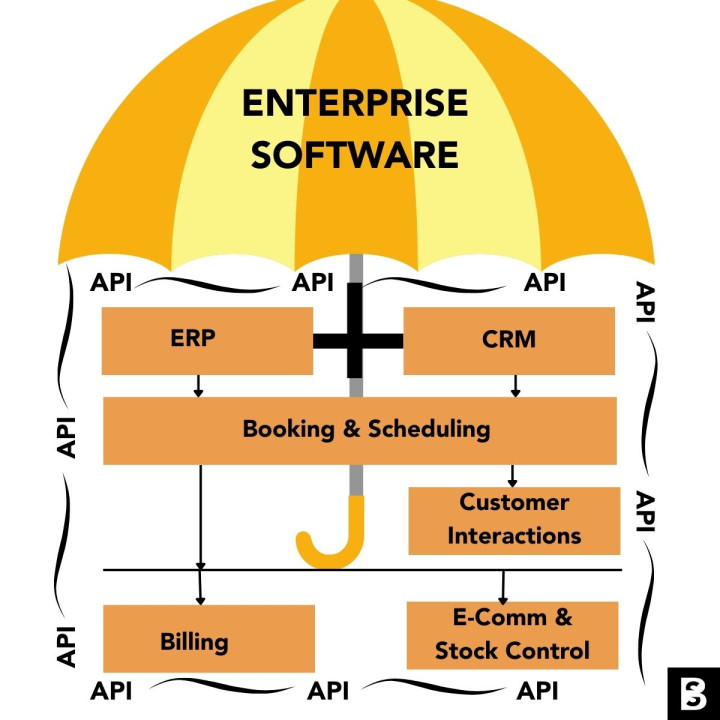
- Purpose: Acts as the connective tissue linking ERP, CRM, e-commerce, scheduling, and other platforms.
- UK Bespoke angle: Strong heritage in Open Banking APIs has made UK firms adept at designing secure, reliable interfaces.
- Why it matters: APIs ensure that enterprise software components don’t operate in silos but in a data-driven ecosystem.
Customised API work typically focuses on:
- Domain APIs that mirror real business language (e.g., Bookings, Allocations, Rebates), not just vendor-centric endpoints.
- Event streams (orders placed, stock adjusted, invoice posted) to decouple systems and enable real-time dashboards.
- Security and compliance (OIDC, fine-grained scopes, auditable consent), aligning with UK regulatory expectations.
Rule of thumb: design for idempotency and versioning up front; your integration surface will change as the business evolves.
5. Booking and scheduling
Read our FREE comprehensive article about Bespoke CRM Software: bespokeuk.com/posts/booking-scheduling-bespoke-software-a-complete-guide
Appointment and resource scheduling software has moved beyond calendars to automated capacity management, pricing, reminders, and no-show mitigation, with vendors infusing AI into routing and demand smoothing. Analysts track steady global and European growth in appointment-scheduling platforms; feature roadmaps increasingly emphasise AI-assisted booking and communications—drivers that often demand tailor made fitting to local processes and branding. Fortune Business InsightsKBV Research
Booking & scheduling systems (especially with AI enhancements) are expanding steadily—likely parallel with or slightly below CRM/ERP growth—but without Bespoke UK CAGR* data, we can’t precisely rank them.
Where UK organisations customise
- Multi-site, multi-role scheduling (clinicians, engineers, rooms, vehicles) with travel time and compliance windows.
- Payments, deposits, and refunds to reduce no-shows—tied to UK payment gateways and accounting.
- Accessibility and inclusivity (e.g., reasonable adjustments at booking) embedded in the flow.
How they interconnect
- APIs = The glue binding everything together into a single enterprise platform.
DID YOU KNOW - History of Booking & Scheduling Software
Common categories of Enterprise Software |
|
ERP |
Integrates finance, procurement, manufacturing, and supply chain. |
CRM |
Manages leads, sales pipelines, customer service, and marketing. |
E-commerce & stock control |
Unifying online stores with fulfilment and inventory. |
API's |
Enabling different systems to “talk” to each other securely. |
*CAGR tells you the “smoothed out” annual growth rate — the average pace of growth per year, as if the market grew steadily at the same rate each year, even if in reality it jumped up and down.
Purpose-built software in the UK has shifted from risky ground-up rewrites to targeted, API-first enhancements around solid commercial platforms. The combination of enduring e-commerce volumes, management focus on productivity, maturing cloud ERP, and a healthy API culture creates ideal conditions to build exactly what makes your business different—without owning more than you must.
Bespoke Enterprise Software - that is what we DO!
Contact us now and find out how our specialised team can solve your businesses pain points USING our UNIQUE Bespoke Software, created by US, personalised to you by US and maintained by US.
bespokeuk.com/contact
2026 Colours trends for website design
2026 Colour Trends for Website Design Digital spaces are undergoing a prof...
8 min read

Google analytics dropping?
1. Google Analytics The old version of Google Analytics (known as Universa...
5 min read
Stop business subscriptions with Bespoke software
Subscription Creep: hidden system costs Many business owners genuinely bel...
7 min read
7 Essential Stages to Becoming a Software Architect
7 Essential Stages to Becoming a Software Architect Whether you are upgrad...
6 min read

The definitive guide to MVP development 2026
The definitive guide to MVP development 2026 A Step-by-Step Guide for Star...
4 min read

AI - Game Changer for Data Management
Data classification can feel like trying to sort through a mountain of pape...
6 min read