


The definitive guide to MVP development 2026
The definitive guide to MVP development 2026
A Step-by-Step Guide for Startups and Established Businesses
Building a Minimum Viable Product (MVP) is a pivotal milestone in the lifecycle of any start-up or corporate innovation team. It is the most efficient way to validate a business idea using minimal resources, ensuring you don't spend months developing a product that nobody actually wants.
The MVP framework has become the industry standard because it allows teams to test, learn and iterate with significantly reduced risk. In this definitive guide, we explore the practical strategies for MVP development, ensuring your project yields the insights necessary to build a world class final product.
What is an MVP?
An MVP is the most basic version of your product that allows you to gather validated learning about your customers with the least amount of effort. It isn’t just a "unfinished" product; it’s about finding the quickest path to solving a core problem for your target market. By focusing on essential functionality, you avoid feature creep and keep your initial investment lean.
Step 1: Identify Your Target Market and Their Pain Points
Before writing a single line of code, you must define exactly who your customers are. Understanding their specific pain points is the bedrock of a successful MVP.
- Market Research: Utilise specific data, industry reports and surveys to understand current trends.
- Customer Interviews: Speak directly to potential users. These conversations provide deep insights into user preferences that data alone cannot capture.
- Create Personas: Develop detailed profiles of your ideal users. This ensures every design choice caters to a real human need.
Step 2: Define Your Value Proposition
Your value proposition is a "lift pitch" that explains how your product solves a problem better than the competition. It must be concise, compelling and focused on the unique benefits you bring to the market.
Step 3: Prioritise Features (The MoSCoW Method)
With your value proposition set, identify which features are essential. We recommend the MoSCoW framework:
- Must-have: Non-negotiable features (The core of your MVP).
- Should-have: Important but not vital for launch.
- Could-have: "Nice-to-haves" if time permits.
- Won't-have: Features explicitly excluded from the first version.
Step 4: Choose the Right Technology Stack
Selecting your tech stack is a long-term decision. You need to balance speed with future growth.
- Scalability: Can the architecture handle a sudden influx of users?
- Skill Availability: Is there a local or accessible talent pool for this language (e.g., React, Python, Node.js)?
- Cost vs Speed: How quickly can you get to market without blowing the budget?
Step 5: Develop and Build
Embrace Agile methodologies. This allows for rapid iterations based on real-world feedback. Keep the design clean and the engineering focused purely on those Must have features. Avoid over engineering; the goal is a functional, reliable solution, not a perfect one.
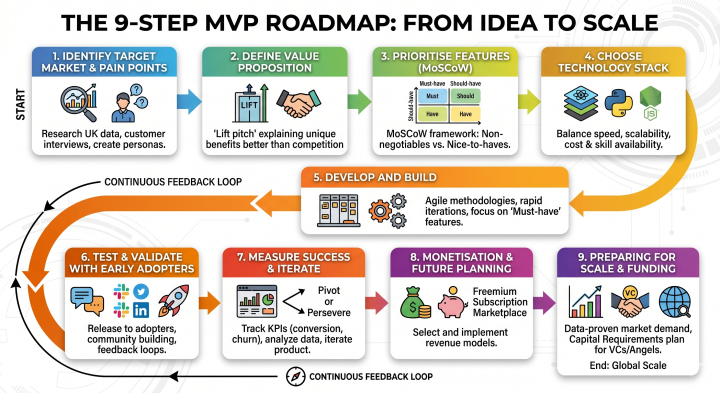
Step 6: Test and Validate with Early Adopters
Release your MVP to a small group of Early Adopters. In the UK tech scene, these users are often your biggest advocates. They are willing to overlook minor bugs in exchange for a solution that solves their primary headache.
- Community Building: Use LinkedIn, Slack or Discord to keep your testers engaged.
- Feedback Loops: Implement tools like Typeform or Hotjar to collect qualitative and quantitative data.
- Observational Testing: Watch how users interact with the UI. Where do they get stuck?
Step 7: Measure Success and Iterate
Establish Key Performance Indicators (KPIs) early. Track user engagement, conversion rates and churn. Use these metrics to decide whether to persevere, pivot or scale. If the data shows users aren't using a specific feature, be prepared to remove it or change direction entirely.
Step 8: Monetisation and Future Planning
How will your product sustain itself? Consider your monetisation strategy early:
- Freemium/Subscription: Monthly recurring revenue (SaaS model).
- Marketplace: Charging a commission on transactions.
- Affiliate & Ad Space: Generating revenue through partnerships.
Step 9: Preparing for Scale and Funding
If your MVP validates your hypothesis, you’ll likely need to secure funding to scale. Investors want to see data. Use your MVP metrics to prove market demand.
When pitching to venture capitalists (VCs) or angel investors, present a clear Capital Requirements plan. Detail exactly how the funds will be allocated—whether for marketing, hiring senior developers, or upgrading your technical infrastructure to handle global traffic.
The Path to Product-Market Fit
Developing a successful MVP is a journey of strategic steps and constant adaptation. By following this guide, you transition from a simple idea to a validated business model. Stay agile, listen to your users and remember: the MVP is just the beginning.
Accelerate your market entry with our MVP development services. Contact us today to launch your high-performance product fast.
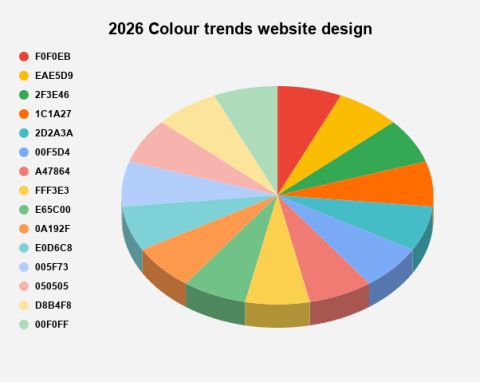
2026 Colours trends for website design
2026 Colour Trends for Website Design Digital spaces are undergoing a prof...
8 min read

Google analytics dropping?
1. Google Analytics The old version of Google Analytics (known as Universa...
5 min read
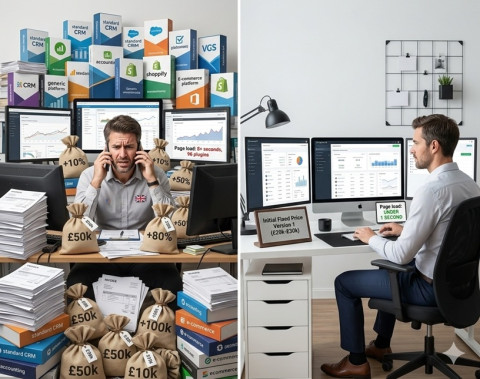
Stop business subscriptions with Bespoke software
Subscription Creep: hidden system costs Many business owners genuinely bel...
7 min read

Seamless Integration: Bespoke Software And Legacy Systems
Seamless Integration: connecting Bespoke Software with Your Tech Stack In...
4 min read

Business sustainability - Understanding Carbon Footprint, Carbon Neutral, and Net Zero
The concepts of carbon footprint, carbon neutrality, and net zero are centr...
9 min read
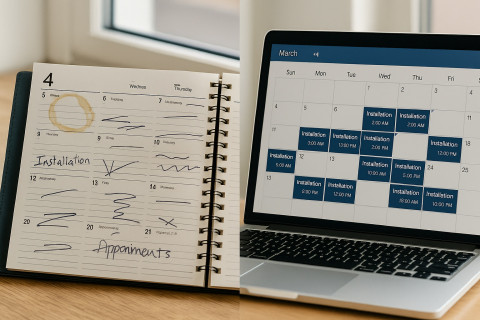
Booking & Scheduling Bespoke Software - A complete guide
The Ultimate Guide to Bespoke Booking & Scheduling Software Time is one of...
4 min read